
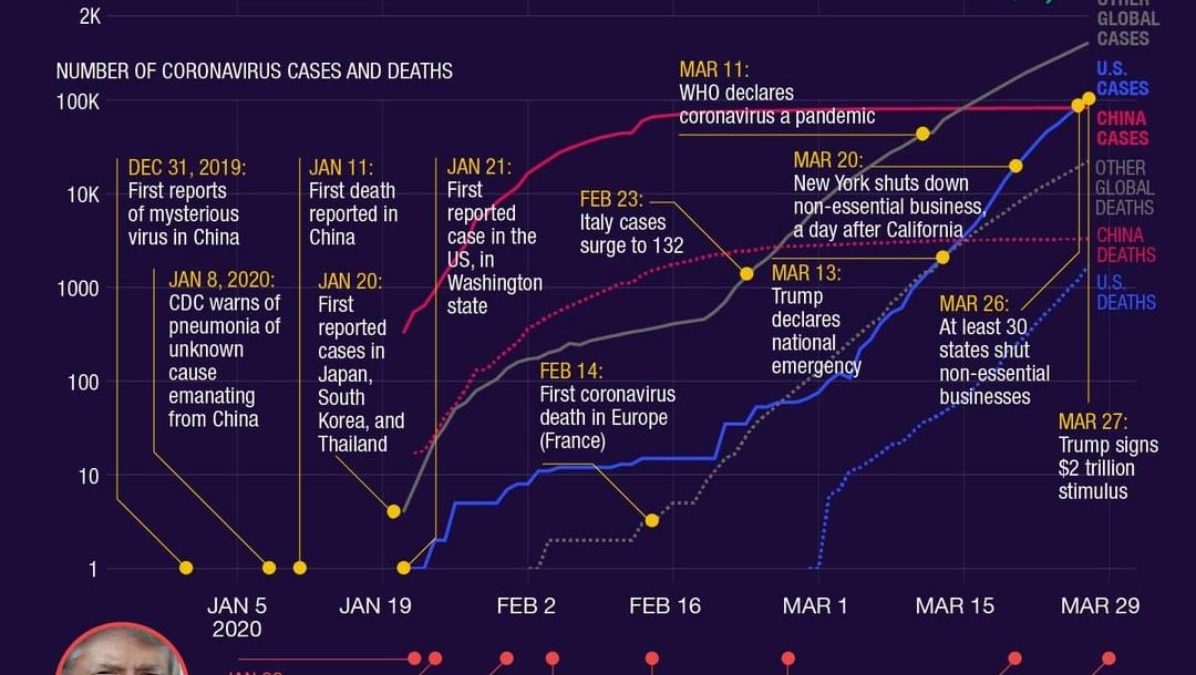
From the World Economic Forum, April 22, 2020
- The COVID-19 story begins on 8 December 2019 when a resident in Wuhan City, China, was found to have symptoms of an unknown coronavirus.
- Key moments include the identification of the disease and its classification by the World Health Organization as a pandemic.
- Amid the suffering and population lockdowns, there have also been significant milestones in global cooperation.
COVID-19 has killed more than 178,000 people so far, with more than 2.5 million confirmed cases globally.
It has brought the global economy to a standstill, with the International Monetary Fund (IMF) projecting global growth will fall to -3% percent this year.
But as some governments now begin to ease restrictions and plan for the future, how did we get here? Here are the pandemic’s key moments.
DECEMBER 2019
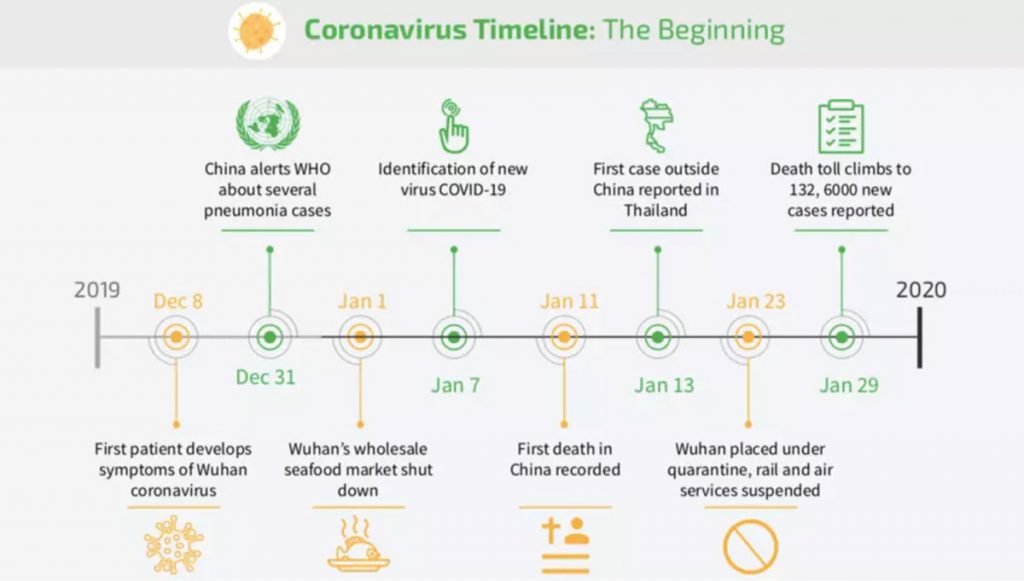
8 December – Wuhan’s first case
The first patient in Wuhan City, China reports symptoms similar to a coronavirus infecti. The disease is thought to have emerged in the Huanan seafood market – although doubts are later cast on that theory.
31 December – WHO informed
China informs the World Health Organization (WHO) about a cluster of cases of pneumonia in Wuhan, Hubei Province. The virus is still not understood.
JANUARY 2020
1 January – emergency footing
The WHO moves into an emergency mode for dealing with a major disease outbreak. Huanan seafood market is shut down.
4 January – cluster of cases
The WHO reports on social media that there is a cluster of pneumonia cases – with no deaths – in Wuhan.
7 January – novel coronavirus identified
The disease is identified by Chinese authorities as a new type of coronavirus, novel coronavir, or nCoV.
11 January – first death reported
The first death from the new coronavirus is reported by Chinese state media – a 61-year-old man in Wuhan died who had underlying health conditions.
13 January – first case outside China
A case of the coronavirus is confirmed in Thailand. It is the first recorded case outside of China.
14 January – WHO warns of risk
The WHO notes there may have been limited human-to-human transmission of the coronavirus and there is a risk of a possible wider outbreak.
20 January – virus spreads to US
The United States announces its first confirmed case – a man in his 30s who had returned from a trip to Wuhan. There are also confirmed cases in Japan and South Korea.
23 January – lockdown begins
Wuhan is locked down by Chinese authorities in an attempt to halt the spread of the disease. Roads are severely restricted and rail and air services are suspended. Foreign governments begin to make plans to evacuate their citizens from the city, although this takes some time.
30 January – Public Health Emergency declared
The WHO reconvenes its organization’s Emergency Committee, two days after the first reports of limited human-to-human transmission outside China. The Director-General declares the outbreak a Public Health Emergency of International Concern.
31 January – US restricts entry
The Trump administration suspends entry into the United States by any foreign national who has traveled to China in the previous 14 days, excluding immediate family members, permanent residents or American citizens.
FEBRUARY 2020
2 February – first death outside China
A coronavirus death is reported outside China for the first time – a man in his 40s from the Philippines.
5 February – cruise ship in quarantine
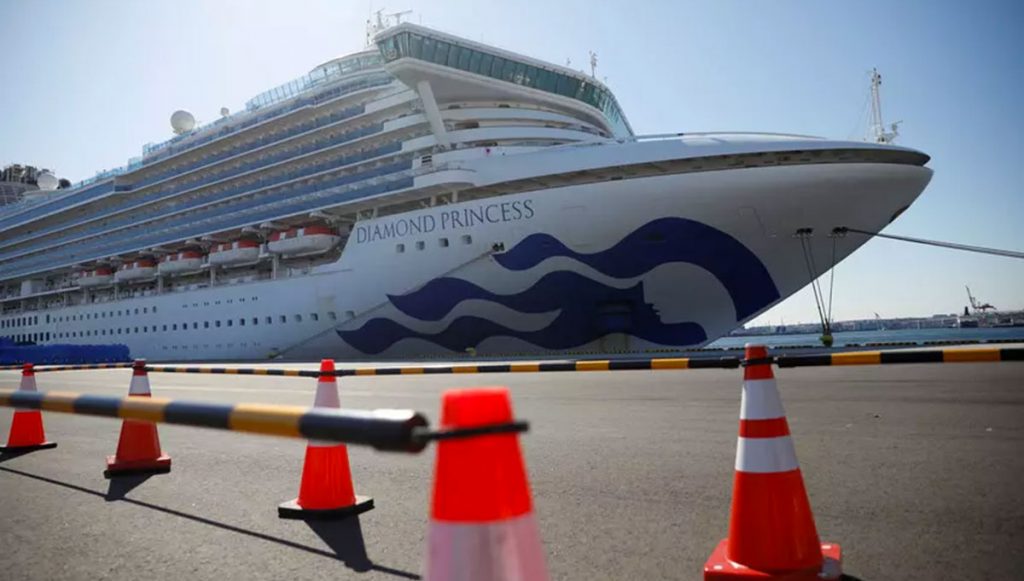
More than 3,600 passengers are quarantined on the Diamond Princess cruise ship in Yokohama, Japan. A large number of passengers test positive and the ship attracts global media attention.
11 February – COVID-19 gets its name
The WHO proposes a new official name for the disease caused by the coronavirus: COVID-19, an acronym for coronavirus disease 2019. The virus that causes it is named SARS-CoV-2 by the International Committee on Taxonomy of Viruses (ICTV).
14 February – first death in Europe
The first European COVID-19 death is announced, in France.
19 February – cases in Iran
Iran announces two COVID-19 cases in the country.
21 February – South Korean surge
The Shincheonji Church of Jesus in South Korea is linked to a surge of infections in the country. The government closes kindergartens, nursing homes and community centers.
23 February – Italy starts lockdown
Italy sees a major surge in cases of the coronavirus and many towns are locked down. It is the first major outbreak in Europe.
28 February – first case in sub-Saharan Africa
Sub-Saharan Africa records its first infection, in Nigeria. The patient is an Italian citizen who had been in Milan.
February 29 – first death in US
The first coronavirus death is recorded in the United States. Travel restrictions are announced.
MARCH 2020
11 March – WHO calls it a pandemic
The WHO makes the assessment that COVID-19 can be officially described as a pandemic due to the rapid increase in the number of cases outside China. President Donald Trump bans most visitors from continental Europe. Global stock markets fall further.
13 March – Solidarity Response Fund launched
The WHO launches the COVID-19 Solidarity Response Fund to receive donations from private individuals, corporations and institutions. The World Economic Forum is also working with its members to assist in the crisis.
19 March – no new local infections in China
For the first time since the outbreak began, all new cases come from outside China. The country’s 3,245 deaths still comprise one-third of the virus’ global toll, but the numbers hold and it is a sign the country has turned a corner.
24 March – key day of milestones
On a key day in the COVID-19 story, the milestone of more than 100,000 patients to successfully recover from the virus is reached, and the lockdown is partially lifted for China’s Hubei Province. In India, Prime Minister Narendra Modi orders a “complete” lockdown for the 1.3 billion population and, in Japan, the Tokyo Olympics are postponed until 2021, ending weeks of speculation over whether they would go ahead in July.
26 March – US hardest hit
The United States becomes the country hardest hit by the pandemic, with more than 80,000 confirmed cases and more than 1,000 deaths.
27 March – Trump’s stimulus package
The next day, President Trump signs a $2 trillion stimulus package into law to address both the health and economic crises.
APRIL 2020
2 April – cases reach 1 million
The number of confirmed COVID-19 cases around the world hits 1 million, with more than 51,000 confirmed deaths from the disease. In the US, figures show nearly 10 million Americans have applied for unemployment benefits.
6 April – UK PM in intensive care
British Prime Minister Boris Johnson, who has been receiving hospital treatment for COVID-19, is moved into intensive care. He went public with his diagnosis 10 days earlier. He is released from hospital on 12 April.Boris Johnson #StayHomeSaveLives?@BorisJohnson
10 April – deaths pass 100,000
The global death toll surpasses 100,000, doubling in nearly a week.
13-15 April – Europe eases lockdown
Some countries in Europe begin to scale back their lockdowns. Austria plans to let DIY stores reopen; Italy plans to reopen some shops; and Spain gets ready to allow some construction and factory employees to go back to work.
14 April – Trump pulls WHO funding
President Trump suspends WHO funding pending the administration’s investigation into the way the organization has handled the coronavirus pandemic. He accuses the WHO of “severely mismanaging and covering up the spread of the coronavirus”. Director-General Dr Tedros Adhanom Ghebreyesus responds that he regrets the decision, while saying the WHO is “focused on stopping this virus and saving lives.”
15 April – NYC tests for antibodies
New York Governor Andrew Cuomo announces NYC will begin daily antibody testing for 2,000 essential workers, hoping to expand to 100,000 tests a day in an effort to lay foundations to get people back to work. And German Chancellor Angela Merkel lays out plans to slowly ease some restrictions in her country.
20 April – lockdown restrictions ease further
New rules relaxing restrictions on farming, banking and public works come into force in India. European countries also took further steps to ease restrictions.